

Counterstory highlights stories erased by mainstream media outlets. Please subscribe, and consider becoming a Paid Subscriber. These stories matter, and deserve to be centered.
The Group stage of the 2026 World Cup are nearing their end.
But the most dramatic football moment took place on the last day of March, more than two months before the beginning of the tournament. The match featured a football rendition of David versus Goliath, which birthed one of the coming World Cup’s most compelling stories and stars.
Esmir Bajraktarevic took position before the ball. The towering Gianluigi Donnarumma, Italy’s goalkeeper and one of the world’s best, stood in front of the Bosnian winger and his nation’s 2026 World Cup aspirations.
Bosnia would advance with a goal.
The Italians would stay alive if Bajraktarevic botched the kick.
Italy entered the match as the heavy favorite. The storied Azzuri have won four World Cup titles, signified by the four stars spangled above the crest on their jerseys. Bosnia and Herzegovina, a nation recognized more for history with genocide than football, has only qualified for the sport’s grandest stage one time before (in 2014).
Everything about this standoff, from its symbolic, sporting and existential dimensions, favored the Italians. They were the considerable favorite, and a World Cup mainstay. But the young Bajraktarevic, who chose to suit up for Bosnia over the United States, had history at his feet. Fourth in the order of penalty takers, a goal would seal Bosnia’s place in the World Cup and send the Italians home. Even more consequentially, a goal would make three-decades’ memory of the Bosnian genocide more current than ever, revitalizing it through the tales of their national team players and the global stage of the world’s most beloved sport.
Bajraktarevic stared down, toward the net, then struck the ball. Donnarumma guessed correctly, chasing down the ball as it paced toward the lower left end of the goal. Seconds and inches determined whether it would be Bosnia or Italy, underdog or giant, genocidal memory or present, that would find its place in the World Cup. It was the young Bajraktarevic, the son of genocide survivors who carries their wounds and the weight of a people stretching from Sarajevo to Saint Louis, standing at the center.
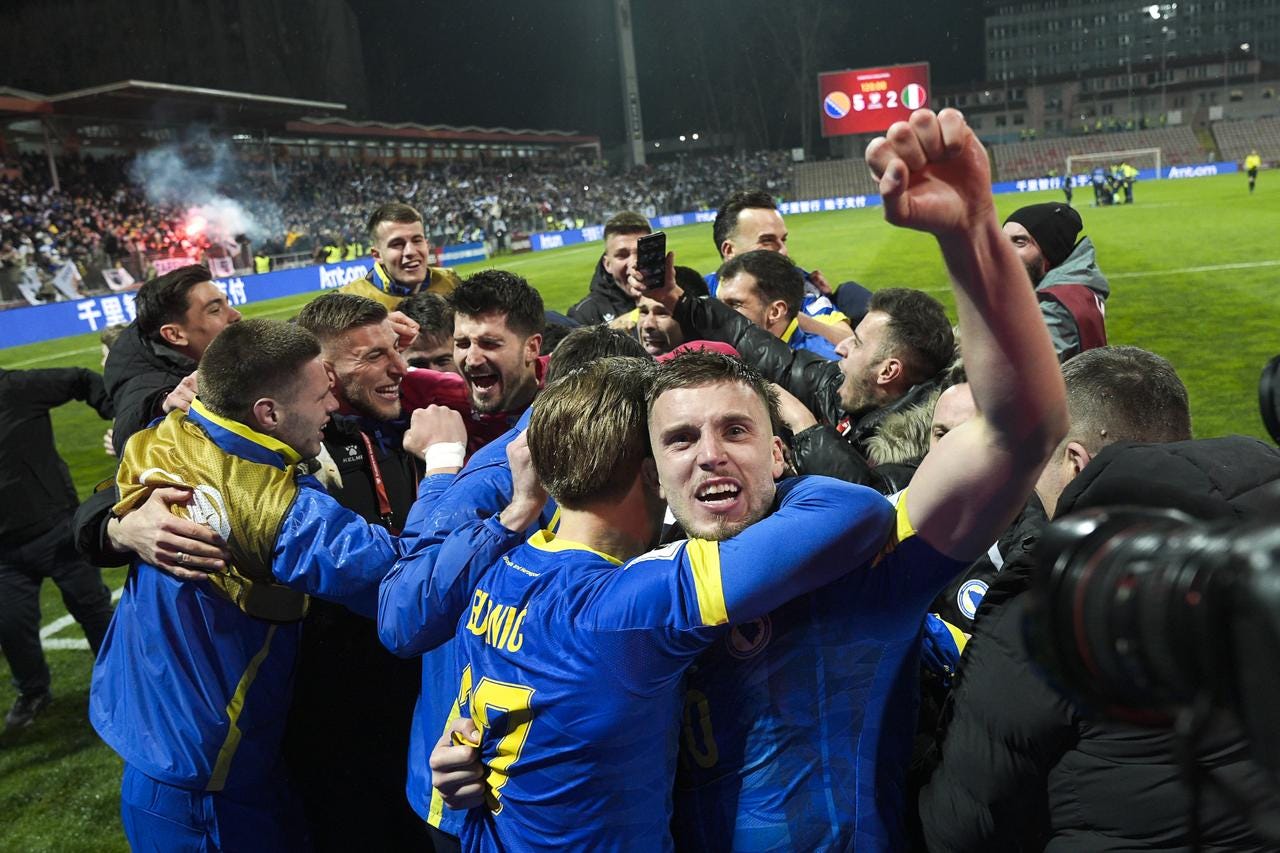
Football, unlike the arc of dominant history, sometimes follows a different course. During its most sublime turns, the sport can write against dominant histories and reverse predictable outcomes. Bajraktarevic’s ball moved beautifully in that direction, past Donnarumma’s outstretched arms and into the back of the net.
Bosnia’s second World Cup qualification followed. Bosnia’s grand narrative of genocide, stitching the personal history of players like Bajraktarevic and the milieu of memories of those inside the homeland and in the diaspora, found newfound relevance. History was no longer the past. But, with Bosnia upending Italy and the odds, history emerged into the thick of the present. The World Cup qualifier was the conduit, and Bajraktarevic’s and his teammates the authors of a rolling narrative rooted in genocide and survival, refuge and resettlement.
Football, for those who look beyond the pitch, is far more than sport. The Bosnian team, poised to kick off their World Cup march on June 12th in Toronto against host nation Canada, manifests its depth and grandeur. The sport is far more than a game, but a delta where memories of tragedy run alongside roaring celebrations of triumph. The Bosnian players on the pitch that defeated Italy were never alone; the ghosts of ancestors taken by genocide and those alive still bearing its scars were always with them. The words of their players, particularly the star-boy from Appleton, Wisconsin, speaks to that.
“My parents lost many members of their family. It’s very tragic. It’s something I will never forget, obviously. Srebrenica is something I will never forget. It’s a part of me and who I am. I carry it in my blood.”
On that fateful March evening in Zenica, Italy was playing against far more than eleven men. But millions in the stands and beyond the stadium, within the bounds of the nation and the brains of a Bosnian diaspora scattered across the world by genocide.
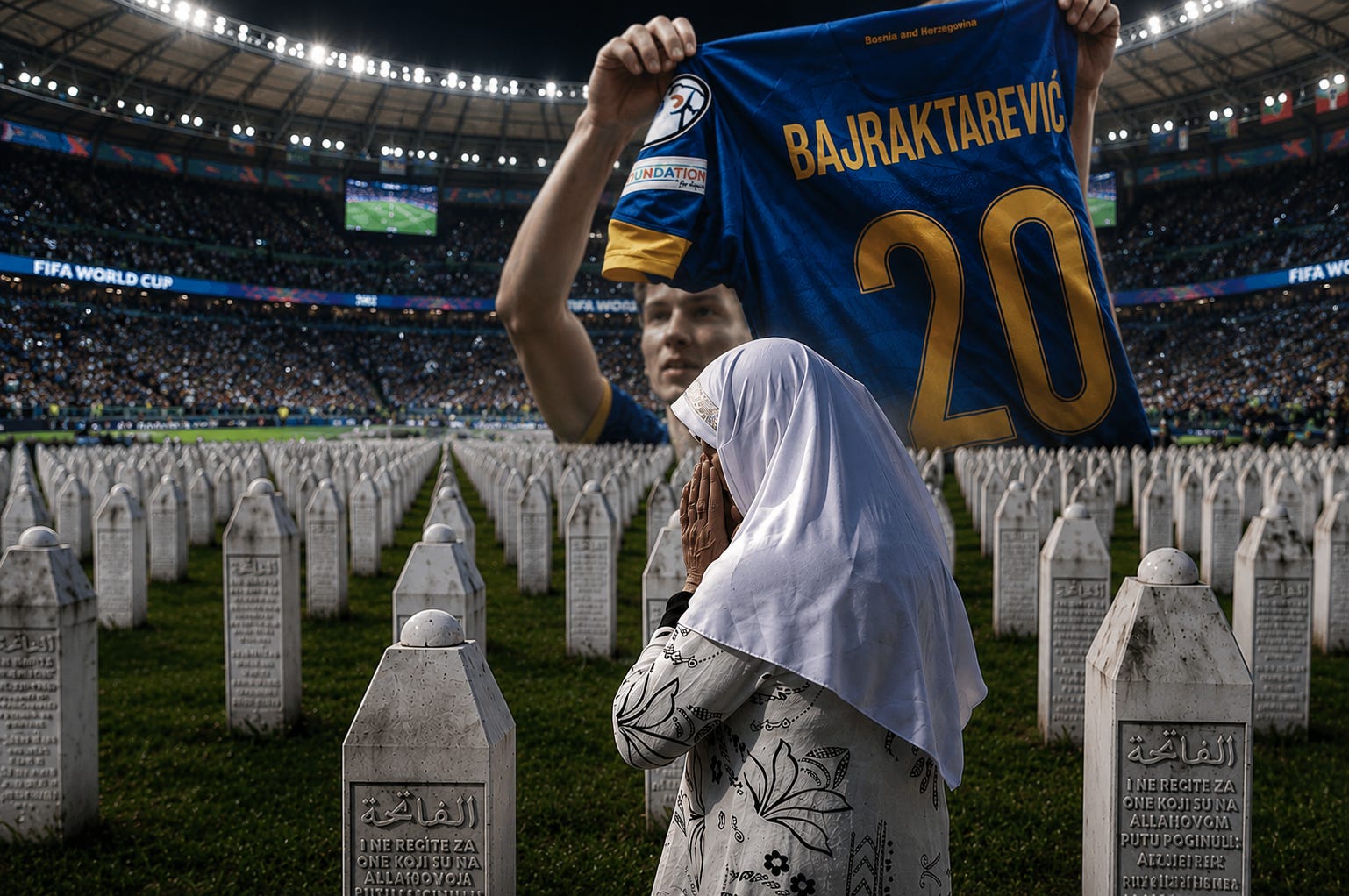
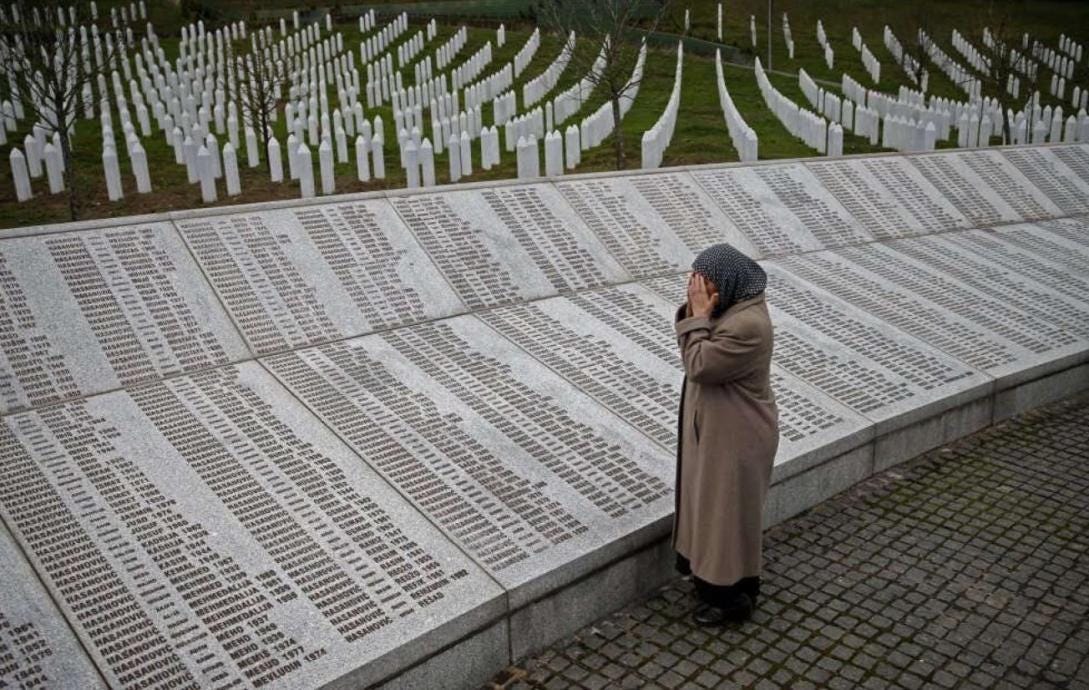
That is precisely how Bajraktarevic found himself in Appleton, Wisconsin instead of Srebrenica. His parents fled the massacres that claimed thousands, rescuing themselves and their yet unborn son. If they would have stayed, the name Bajraktarevic would not have found itself at the center of the football world. It would not be emblazoned on the back of the national team’s royal blue jerseys, but like tens of thousands of others, listed across the tombstones of young Bosnian men lined up in mass cemeteries.
Football had its own plans. The beautiful game tracked a course that disrupted the design of genocide, and delivered a counter-story that struck back at it. For Bajraktarevic, a young man who has become a Bosnian everyman, embodying what and who the boys, teenagers, and young men massacred by the genocide could have become. He represented them, his people, and a national tragedy pushed to the margins of history.
“There was a plan so that his boy could never be born,” Emir Suljagic, head of the Srebrenica Memorial Center, said of Bajraktarevic. There was a Serbian design, thirty-one years ago, that systematically murdered more than eight-thousand Bosnia – the majority of them boys and men.
Again, football had other plans. It birthed a story of a Bosnian American boy who had history at his feet. He rose to the moment because it was made for him. Victory was sealed before he struck the ball. Bajraktarevic embodies the afterlife of a genocide that could not kill a people; that could not abort subsequent chapters of scattered survival, transcendence and triumph.
Italy never had a chance.
Bosnia, anchored by team legend Eden Zheko and Bajraktarevic, the native son who delivered the nation its second World Cup bid, march onward. The past and the present, politics and play will blur together, powerfully, when Bosnia takes the World Cup pitch this month, rewriting the darkest chapters of history under the beautiful game’s brightest lights.
History is being rewritten, right now, on the football pitch by Bosnia. After drawing with Canada, losing to Switzerland, and today, defeating Qatar, Bosnia is on the cusp of advancing to the World Cup knockout stages. For the first time, ever. In the words of Nigerian author Chinua Achebe, “Until the lions have their own historians, history of the hunt will always glorify the hunter. Bosnia, on the football field, has found its lions.
Khaled A. Beydoun is a law professor and writer. He is the author of the critically acclaimed book, American Islamophobia: Understnading the Roots and Rise of Fear. He will be covering the 2026 World Cup on Substack, social media, and beyond.