


Rivalries sell fights. But the one circling Khamzat Chimaev and Sean Strickland doesn’t just sell peddle a prizefight, it traffics in something older, uglier, and far more durable than sport that mars our current politics: racial hatred.
Chimaev walks into the octagon already written. A Muslim man, Chechen-born, embodying the visual and political script of two decades of American Islamophobia and media mythmaking. Unlike Strickland, he doesn’t need a microphone. The story is imposed on Chimaev just like it is on all visibly Muslim men: he represents menace, extremist, threat. His violence is not confined to sport, but read as cultural, political and civilizational. Every media appearance, press conference, and in-cage takedown is folded into a script that predates him.
Strickland, meanwhile, writes in bold ink; and the UFC hands him the pen. In the buildup to UFC 328, the white middleweight challenger has leaned hard into the language that makes Chimaev legible as civilizational enemy rather than an opponent. “Terrorist” and “Taliban.” “Goat-fu**er” and “third-world dog” spew freely from his mouth, accompanied by the UFC logo prominently showcased on the mic in front of it and the banner behind. These are not metaphors tossed off in the heat of promotion, but a steady vocabulary that collapses Muslim identity as the enemy of America. In one exchange, Strickland framed Chimaev as “raised in violence,” implying that Chimaev’s background, not his training, explains his invincibility and unbeaten record.
The insinuation is clear: the Chechen’s rise to champion was reared by savagery, not skill. Tropes emboldened by the War on Terror, and dangerously made explicit by Donald Trump and the far-right movement he ushered in. Strickland, a fighter and follower of that movement, takes every opportunity to racialize his rivalries. This time, tapping into the virulent strains of Islamophobia dominating the American political discourse to demonize Chimaev.
Racism wins votes and elections within the realm of politics. In the UFC, it wins legions of rabid fans and the promotional wind at your back.
Strickland’s persona thrives on escalation and animus. He has repeatedly used homophobic slurs to signal contempt for queer people, cast LGBTQ visibility as cultural decay, and laced interviews with misogyny that reduces women to symbols of a “degenerate” society. None of this is accidental. It is a performance that converges with the UFC’s strategic alliance with this White House. An alliance that, according to MMA journalist Luke Thomas, “whitewashed Trump’s image” in order to win his second presidential term. That transaction not only benefitted Trump’s presidential return, but will be paid back to UFC boss Dana White this June 14, 2026, with the “UFC Freedom 250” card hosted on the White House lawn.
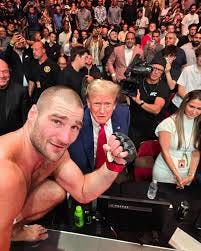
Strickland’s embodiment of an Americana steeped in racism and nativism is, with that historic event in one month, a prequel.
But what makes this rivalry combustible is not just what is said by Strickland, but how it is received. Strickland’s rhetoric is framed as raw, unfiltered, real, and most dangerously, to be protected as “free speech.” Chimaev’s identity, on the other hand, is framed foreign, suspect and menacing. One man’s words are excused as personality; the other man’s presence is treated as politics. Strickland’s hate is protected by “free speech,” while Chimaev’s political views clash with the partisan allegiances and geopolitical alignments of the UFC and its broadcast partner, Paramount.
This is the UFC’s promotional alchemy: converting prejudice into promotion by leveraging a selective enforcement of free speech. The more Strickland invokes “terrorists” and “Taliban,” the clearer the storyline becomes for a segment of the audience primed to see Chimaev as more than an MMA fighter, but a civilizational enemy. Strickland’s press conference performances makes this patently clear, particularly when he shouts “America, America!” to fans that rage back with cheers to his rhetorical red meat.
No major sporting league sanctions this brand of hate. Despite the UFC’s rapid climb in popularity, and the organization’s emergence alongside the NFL, NBA, and MLB as a leading sports attraction in America, it carries the distinction of not only refusing to punish the unhinged racism trumpeted by the likes of Strickland, but featuring it prominently as a marketing strategy. Therefore, Strickland announcing that Chimaev represents “the takeover of Sharia Law” and Muslims like him want to “wrap their wives in towels” are not the aberrant views of one deviant fighter, but unfiltered projections facilitated by an organization that united with the far-right and its principal mouthpiece, Donald Trump, as corporate strategy.
Sean Strickland won the fight. But UFC won something larger: a spectacle where racism is not a liability, but a marketing asset. And in June, with Donald Trump presiding over as president and ringleader, it will parade violently across the White House lawn.
Khaled A. Beydoun is a law professor and writer. He is the author of the critically acclaimed book, American Islamophobia: Understanding the Roots and Rise of Fear. He will be covering the 2026 World Cup on Substack, social media, and beyond.
Yet more degeneracy. Mainstream America is going backwards.